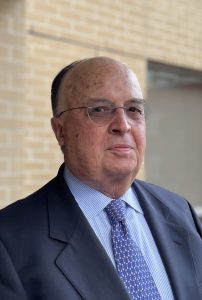

Professional Profile
Mauricio Ospina is the Area Director for the U.S. market for the Government of Ontario and a pioneer volunteer within Canada’s Hispanic community. Listed in Canadian Who’s Who, he has championed institutions and programs that open doors for immigrants and entrepreneurs.
He founded the Canadian Hispanic Business Alliance (2006) and the national "10 Most Influential Hispanic Canadians" program (2007), and co-founded Hispanotech (2009). He also co-led the initiative to declare October as Hispanic Heritage Month in Toronto and Ontario, a designation now adopted at the federal level.
As a Fellow at York University and a community advisor, he has fostered scholarships and business ties, and has led delegations to meet with Prime Ministers and federal leaders. His work has been highlighted by The Globe and Mail, the Toronto Star, CBC, and Hispanic media. Coming from humble beginnings—arriving with no English or resources—he remains steadfastly committed to strengthening the Hispanic presence in Canada.
When Mauricio Ospina arrived in Canada in 1991, he was 23 years old, armed with a technical diploma from SENA, a bit of self-taught French, and a heart full of hope. He spoke no English, had not completed a university degree, and had no contacts or support networks. “I literally started from the bottom,” he recalls. “It took me six or seven years to reach a point where I felt I had achieved something I had set out to do.”
Today, Ospina represents the Government of Ontario in the U.S. and across the Americas. He is a pioneer in creating organizations that promote Latino leadership and has been included in Canadian Who’s Who, a distinction reserved for the country’s most influential figures. His name is tied to key initiatives such as the Canadian Hispanic Business Alliance (2006), the national program 10 Most Influential Hispanic Canadians (2007), and Hispanotech (2009). He was also one of the driving forces behind Hispanic Heritage Month in Ontario, later adopted at the federal level.
None of this seemed possible during his first years in Toronto. He arrived in the middle of a deep economic recession. It took him over a year to find work, and he spent three and a half years cleaning floors. “At that time, the Latin community was not organized: there were social and sports clubs, but we were few and scattered. I had no money, no English, no Canadian experience. It took me three and a half years to learn the language and then four years of study to get on track.”
That quiet, unglamorous work also marked the beginning of his transformation. While his hands worked, his mind kept planning. One day, he says, he realized he had to change from within. “I discovered that my dream was to work in international trade representing a government—and that’s what I do today.”
As his corporate career advanced, he made himself a promise: to help whenever he could. He identified a clear gap in the Hispanic community—the absence of professional and business structures that could provide information and support. “Since no serious organizations existed to offer professional and business resources to the Latino community, I decided to create them. I founded five organizations, and all are still operating.”

That decision—born not of ambition but of commitment—became the starting point of an institutional legacy that today supports hundreds of Latino professionals and entrepreneurs in Canada. Yet beyond the structures, Ospina has also built a personal legacy grounded in a simple philosophy: focus, discipline, and perseverance.
“First: forget about your country of origin for a while and focus on understanding the new one. Read the local news, watch television to learn everyday language,” he advises newcomers. “Second: write down your goals. I once had 32, then I combined them down to 10, and finally to 3. Over time, I achieved them all. The rest is a bonus.”
He speaks with conviction but without boastfulness. He believes part of success lies in turning challenges into strengths. “The accent doesn’t matter. You must use your ‘weaknesses’ as strengths. Coming from a country with fewer economic resources allowed me to see different solutions, to be more innovative and creative. For me, the essential thing is to focus on solutions, not problems.”
This ability to find answers, to improvise in difficult environments, is not, in his eyes, an individual trait but a cultural one. “Yes, absolutely. In our countries, if it rains, you still find a way to get there, even knowing it will be hard. That resourcefulness is something we bring with us. Here in Canada, many things are already solved, but we arrive with the ability to invent solutions.”
Still, he recognizes that much remains to be done. “I always say that Hispanics are Canada’s creative class. We are present in many sectors—government, private enterprise, different industries—but we don’t dominate any. Ideally, we should manage to do so in at least one sector or region.” For this, he insists on two priorities: more entrepreneurship and greater political engagement. “Look at the Korean community: during a World Cup, when the National Post published an editorial against Korea, they stopped buying the paper for ten days. On the eleventh day, the newspaper had to issue a public apology. That is community power.”
Amid his institutional work, public commitments, and role as a reference point, Ospina keeps his personal foundation intact: family. “I’ve learned that dedicating time to the community is more fulfilling than focusing only on making money. Money doesn’t bring the happiness I seek. My family, and especially my daughter Daisy, is what matters most. That balance keeps me focused and prevents me from losing myself chasing goals that would not make me happy.”
Looking back, and thinking of those just beginning their migrant journey, Mauricio offers three simple but essential recommendations: “One: make a list of the things you want to achieve. Two: read the local newspaper and watch plenty of Canadian television. Three: never give up. From those 10, 20, or 30 goals, keep combining them until you find your way. The key is perseverance—the berraquera we bring from Colombia.”
That spirit—a mix of realism, faith, and stubborn determination—is the thread running through his story. The story of a man who began by mopping floors and today represents a government. But above all, the story of someone who carved a path not only to advance himself, but to make it easier for others to follow. A quiet leader who inspires not just by what he has achieved, but by how he has achieved it.